
Tricycle is pleased to offer the Tricycle Talks podcast for free. If you would like to support this offering, please consider donating. Thank you!
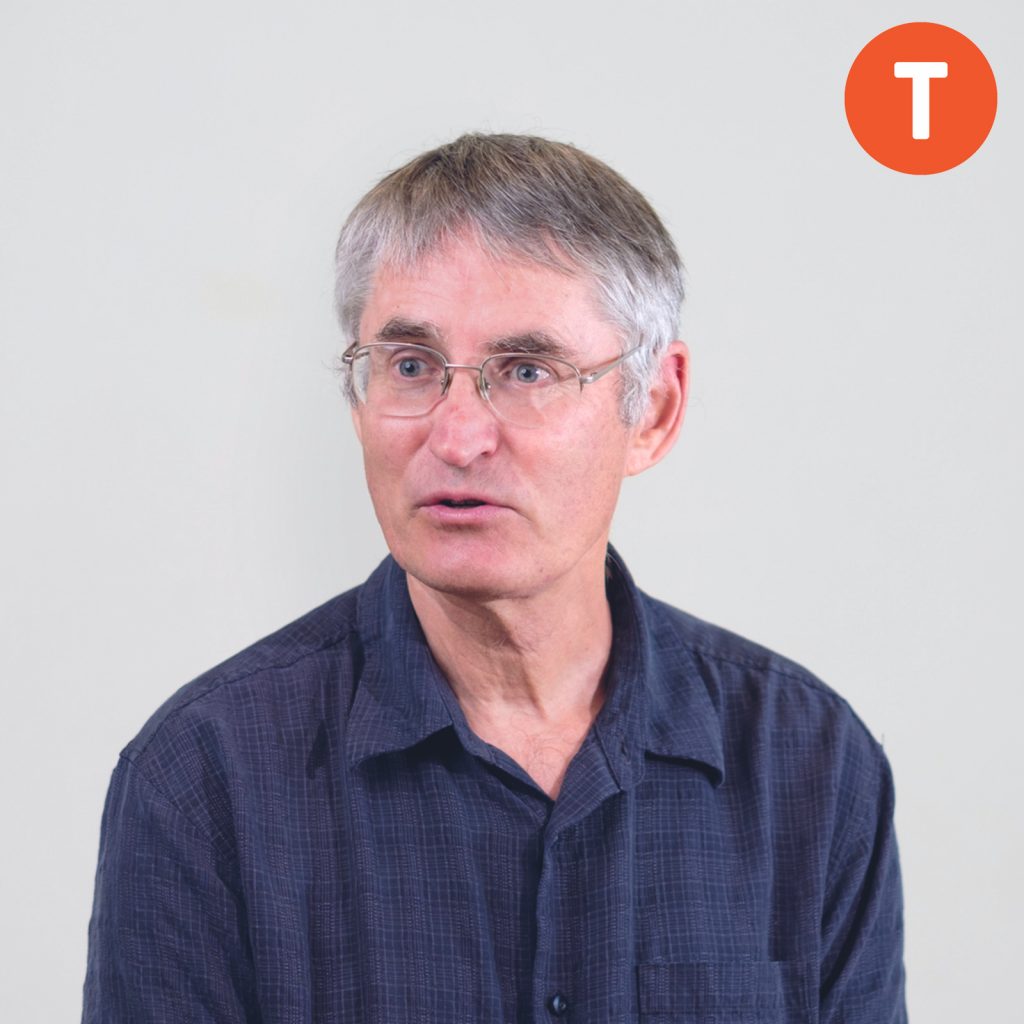
Gil Fronsdal is a dharma teacher at the Insight Meditation Center in Redwood City, California, and at Spirit Rock Meditation Center in Woodacre. He has practiced extensively in the Soto Zen and Theravada Buddhist traditions, and he draws from both traditions in his framing of what he calls naturalistic Buddhism.
In this episode of Tricycle Talks, Tricycle’s editor-in-chief, James Shaheen, sits down with Fronsdal to discuss what he means by naturalistic Buddhism, how we can train ourselves in what we want to become, and how the practice of naturalistic Buddhism can help us become free.
Tricycle Talks is a podcast series featuring leading voices in the contemporary Buddhist world. You can listen to more Tricycle Talks on Spotify, Apple Podcasts, and iHeartRadio.
♦
We’d love to hear your thoughts about our podcast. Write us at feedback@tricycle.org.
Read transcript
Gil Fronsdal: In the West, we use the word “practice” a lot to refer to what we do, and we ask each other, “What is your practice?” And it’s fairly common for people to give a technique or a school of Buddhism that they practice in or something as an answer. But the most common word that’s used in the ancient language is bhavana, and bhavana means to grow and to cultivate. And so one way of looking at this tradition is it’s not about what you practice; it’s all about what are you growing? And if we ask each other not what is your practice, but ask each other what are you growing, I mean, people will stop and think and reflect, and then it becomes a whole different kind of world we live in when it’s about growing something. What are the good qualities? What is the goodness? What is the value? And then we’re talking about something natural that we’re capable of, we’re naturally capable of growing, cultivating, and the so-called training is not about making anything happen but creating the conditions, the supportive conditions to allow seeds inside of us to grow and become full. James Shaheen: Hello and welcome to Tricycle Talks. I’m James Shaheen, and you just heard Gil Fronsdal. Gil is a dharma teacher at the Insight Meditation Center in Redwood, California, and at Spirit Rock Meditation Center in Woodacre. He has practiced extensively in the Soto Zen and Theravada Buddhist traditions, and he draws from both traditions in his framing of what he calls naturalistic Buddhism. In my conversation with Gil, we talk about what he means by naturalistic Buddhism, the centrality of non-clinging across Buddhist traditions, what it means to let go of our clinging to views, and how we can practice peace in daily life. So here’s my conversation with Gil Fronsdal. James Shaheen: OK, so I’m here with Gil Fronsdal. Hi, Gil. It’s great to be with you. Gil Fronsdal: Likewise, I’m delighted to talk to you. James Shaheen: So, Gil, you describe yourself as a natural Buddhist, a term you distinguish from secular Buddhism. So to start us off, what is natural Buddhism? Gil Fronsdal: These days, I’m using the word naturalistic. I don’t know how significant that difference is, but the primary difference is that I rely, I believe, a hundred percent on experiences that I can verify for myself, beliefs, Buddhist teachings that I can really know for myself through my own practice and experience. And so it’s a contrast to supernaturalistic Buddhism, meaning the Buddhism that’s based on pretty classical and historically central Buddhist teachings that I can’t verify for myself and that I’m asked to take on faith, you know, ideas of rebirth, ideas of heavens and hell, of celestial beings, of a variety of things like this that the only way that I can somehow work with them is if I took them on faith, but I’d rather not do that. I don’t find the need to do that, and for all these fifty years of Buddhist practice, I’ve had a lot of teachers, and none of the teachers I studied with in the United States and in Japan and in Southeast Asia ever seemed to expect me or want me or told me to believe anything more than what I can verify for myself. James Shaheen: Mmhmm, so that would include rebirth or the working of karma across lifetimes. Those things weren’t really relevant to your practice. Gil Fronsdal: Exactly, I don’t want to dismiss them or I don’t want to be disrespectful of them. It’s just that that’s not what I base my own practice in Buddhism on, and as a Buddhist teacher, then I have to make choices about what I’m going to teach, and I think it’s safest to teach what I know for myself. Occasionally, sometimes I’ll refer to the Buddha or the teachings, but it’s usually those aspects of the teachings that work for me in this direct, naturalistic, experiential way. James Shaheen: You know, I heard you give a talk in 2013 at the Barre Center for Buddhist Studies, and I assume this is still true, you ground your understanding of naturalistic Buddhism, I’ll call it now, in the Book of Eights, which some consider to be one of the earliest Buddhist discourses. So can you give us some background on the Book of Eights? How does it inform your practice and your understanding of dharma? Gil Fronsdal: Yeah, well, probably when I came to it and studied it, I loved the book. It wasn’t so much that it informed me but probably just supported me. I first encountered the book forty-some years ago. I was then a Zen student then, and people were saying that the Book of Eights was a kind of a proto-Mahayana or proto-Madhyamaka, or proto-Zen in the earliest tradition. What they seem to be pointing to and was there was there were almost no supernatural beliefs there. The idea of future or future rebirth was considered to be unnecessary in this text: A sage is not concerned with becoming or non-becoming, not concerned about what happens after they die, and is not concerned with taking anything as being ultimate. There’s no idea of an ultimate truth that this is what we have. We’re special because we know what’s really true, the ultimate truth. That’s considered to be a form of clinging or delusion to take anything as the ultimate. And what the text falls back on over and over again is non-clinging, non-craving, and that’s what a sage does. There are even suggestions in the text that you’re not supposed to even rely on religious practices. I don’t think it’s saying don’t do religious practices, but that religious practices are not the point. The point for a sage is to live a life of non-clinging, and the way it’s depicted in that text is how they live this life here and now. James Shaheen: So, you know, you mentioned the word faith earlier, and you note that faith is mentioned only once in the Book of Eights, and it appears in a passage stating that someone who has attained peace has no need for faith. So what does the Book of Eights teach us about Faith? Gil Fronsdal: Well, it doesn’t, maybe beyond that, nothing. But it maybe indirectly teaches that there is a way of knowing for yourself clearly, directly, to see. The key activities that the text talks about is seeing and knowing for yourself, and so the idea is that there’s something you can see and know for yourself that doesn’t require faith. James Shaheen: You know, I imagine some of our listeners would feel that something is lost when we ignore faith. So how do you respond to that? Gil Fronsdal: We don’t have to jettison faith. I have a strong faith. I love my faith. It’s a heartfelt, wholehearted, warm, inspired feeling about practice, Buddhism, and my communities that I practice in. So faith, I think, is kind of a wholehearted confidence, a wholehearted inspiration. Those are really great qualities. But to not get sidetracked by it so that we don’t do what in the Book of Eights is the direct path, the path of just really seeing where we cling and seeing the alternatives to clinging. James Shaheen: Mmhmm. So you note that rather than focusing on a transcendent, supernatural reality to be attained, the Book of Eights emphasizes the psychological state accessible to all of us. So can you say more about this direct approach to attaining peace in daily life? Gil Fronsdal: You know, the Book amazingly does not say much about how to attain it. It’s kind of like Krishnamurti almost, who didn’t really offer anybody any practice in his radical pointing to being free here, not clinging to anything here. And so what makes the Book of Eights so radical is there’s not an instrumental way in order to do this work. It’s not like you have to do something to be able to not cling. In my reading of the book, there’s a wonderful harmony or oneness connection between the goal and the means. The means and the practices contain the goal in it. So if the goal is non-clinging, we start by non-clinging. And even though we can maybe begin very, very small little steps, those small steps contain the goal that we’re looking for. We get the results, we get the affirmation or the confirmation in the small steps that then inspire us to continue until those steps become bigger and bigger. James Shaheen: It’s kind of like just do it, right? Gil Fronsdal: Yeah. James Shaheen: So the Book of Eights emphasizes clinging, as you mentioned, as the primary impediment to peace, and one way of releasing clinging is letting go of views. Now that’s a big one, especially in today’s day and age. So can you tell us about the importance of not clinging to any views? Gil Fronsdal: Well, I think the operating word is clinging. I don’t think the text says, “Don’t have any views.” But don’t cling to them and don’t cling to views as what it’s going to take to become free of clinging, and don’t confuse views with the goal, but there might be all kinds of views, all kinds of orientations, all kinds of interpretations, all kinds of frames or references we use in order to live wisely in this life. I think we can’t do without views, but for the purposes of our freedom, don’t rely on views. James Shaheen: Mmhmm. So you note that this teaching on letting go of views can be a radical message, as it undermines the importance of religious doctrines. Can you say more about that? It goes against this sort of doctrinaire approach to Buddhism or really any other religion. Gil Fronsdal: Yeah, well, one of the wonderful teachings of the Book of Eights is not to be in contention with anybody else’s religion or their views. It emphasizes non-contention or non-conflict with other people. So non-clinging doesn’t mean that you have a view of the ultimate or what is true that you then use to counter other people of “You’re wrong and I’m right.” In a way, we’re leaving people alone to have their views and not arguing with them. But a close kind of partner to the Book of Eights in the ancient teachings of the Buddha is the Kalama Sutta, where a group of people come to the Buddha, and they say, “A lot of teachers come through here and they all claim to know the truth. Which of them is right?” And the Buddha ignores the question. He’s not going to answer questions of right and wrong about what the truth is, but he does say in a pointed way, and this is kind of a challenge for a lot of religious people. So it is a challenge, but it’s not meant to be a direct challenge, I believe, and he says, “Don’t rely on your traditions. Don’t rely on your sacred books. Don’t rely on your teachers or your denomination or lineage. Don’t rely on your logic. Don’t rely on your reasoning and what you think. Don’t rely on popular views around you.” So all these things that are sources for beliefs, he pulls the rug from under. He says, “Don’t rely on that. Rather, rely on what you can know for yourself.” And in the West, many teachers love the Kalama Sutta, and they stop right there and they say, “Just know for yourself.” But the Buddha actually didn’t stop there. He then provided criteria of what is useful to know for yourself. And so he gave five criteria: Is it wholesome or unwholesome? Is it harmful or is it beneficial? Is there something about it that feels off? Is it faulty or not faulty? And then he also includes the interpersonal world as part of that consideration. He refers to the people who are wise. I like to interpret him meaning the wise people whom you really respect a lot. Do they praise or do they not praise this behavior? And so, you know, for me at least, there are people whose views about my behavior I kind of want to take into account. Some of my teachers I have, you know, I want to be at my best ethical behavior around them, because I have self-respect, and so in their presence, that self-respect gets lifted up nicely. So he offers these criteria, and the criteria he offers as an alternative to these sources of usual religious knowledge is personal experience: things you can kind of know for yourself, including knowing what your teachers say, but not what they say about doctrine, but what they say about behavior. James Shaheen: You know, Gil, you know the Pali canon better than I do. You’ve translated the Dhammapada, I think you translated the Book of Eights. And there was a time historically when Buddhism was the new kid on the block and asserting itself, and there are accounts in the Pali canon of the Buddha responding to Brahmins and basically using logic and reason to not undermine but point out maybe the inadequacy of their views. So there is this sort of argumentation that takes place that has everything to do with right view. I don’t know how you translate right view, but it’s not right in the sense that I’m right and you’re wrong, but it’s the proper view, I suppose, according to Buddhism. So how do you view those, I don’t know if they’re quite conflicts, but arguments or Buddhism asserting itself in the face of competing belief systems? Gil Fronsdal: Yeah. Well, it’s possible that when we look at this that the Buddha is concerned that certain beliefs take people away from using their own direct experience as a path to freedom. And so sometimes he’s very explicit where he doesn’t sometimes deny or reject the opinions of other people. He just simply doesn’t pick it up. He says that this is what people will say who don’t really see deeply. So he’s not saying it’s necessarily wrong, maybe that’s implied, but it’s not really onward leading. And so he wants to say, well, that doesn’t lead to freedom; this is what leads to freedom. And so he does this particularly with religious metaphysics of views about ultimate reality, ultimate life, future lives, ultimate consciousness, all kinds of things that are kind of ultimate. He says that believing in that is not onward leading. And what he says is that what’s onward leading is the direct insight into your own suffering and freedom from suffering. And so sometimes he’s not necessarily saying no to people, but he’s saying that it’s not onward leading. The place where he really uses logic to argue with the Brahmin the most, where he really kind of turns their beliefs upside down and really holds them accountable to them, and it’s really a debate, the primary ones that I know about have to do with Brahmin beliefs in their own superiority, so the class system or the caste system in ancient India, and he’s not going to put up with that one bit, so in that he’s fierce. James Shaheen: Right. I mean, he points out that one is not noble by birth, but rather by action. Is that correct? Gil Fronsdal: Yes. James Shaheen: And it’s so consistent with democratic values, which is important nowadays. Right? Gil Fronsdal: Yeah. How we act is so important. So that’s why I think the Book of Eights keeps putting us back to our behavior and our clinging, and I would say the naturalistic current in ancient Buddhism, there’s a strong naturalistic current. Whether it represents the Buddha entirely, I don’t know. It’s so hard to tease apart the historical layers of these ancient texts, but there’s certainly a very strong current of naturalistic Buddhism that puts primacy on not causing any harm. Nonharming is the fundamental basis, I would think, of early Buddhism, and what’s interesting is the harm simultaneously can be both to yourself and to others. It’s hard to intentionally cause harm to others without harming yourself. James Shaheen: You know, at the Met a few years ago, at the Metropolitan Museum of Art, they had an early Buddhist art exhibition, which was really extraordinary. But the very early art is highly naturalistic. And so I had to think of you when I saw it, because there are trees, there are yakshas, there are forests. You know, everything is very natural, part of the natural world, that the Buddha and the dharma are part of this natural world. James Shaheen: The Book of Eights also describes the quality of a sage or a person who was let go of clinging, and you referenced this a little bit earlier, and you note that the sage is not described using the typical terms of arhat, stream-enterer and so on. So how is the sage described? Gil Fronsdal: Yeah. The primary way is that they say a sage knows and sees, so they have this direct insight. and they’re peaceful and happy. And probably in the suttas as a whole, one of the most common positive characteristics of an arhat is that the person is peaceful and happy. And so in the Book of Eights, the sage, it’s called the sage there more often than not, is someone who doesn’t move through the world causing conflict. James Shaheen: So you note that a significant attribute of the sage is, is the sage’s ability to know and see; what is it that they see? Gil Fronsdal: Oh, they see the problem. They see suffering, and they see the clinging. That’s the heart of their seeing. They really know and really take seriously the fact that they suffer. There’s clinging, there’s craving, and they see—and this is the important part, otherwise it makes no sense—they see directly that there can be an absence of craving and absence of clinging and absence of suffering. So I think a sage is someone who can see both, and when you see both side by side, it makes a world of difference. If you only see clinging and craving, if you only see how we get swept up in our attachments and that’s all that exists, we see the world in a skewed way. But if you can have the overview, the larger view, that can see both clinging and non-clinging at the same time, that gives a whole different perspective of how to go forward. We see the solution in the very insight that we have. James Shaheen: Right. You say sages know and see ways in which people struggle and they see peace in what needs to be abandoned in order to attain this peace. Gil Fronsdal: Yeah. James Shaheen: So another theme of the Book of Eights is training or doing practices conducive to peace. So what does this training look like? Gil Fronsdal: That’s a good question. It talks about it some near the end of the Book of Eights, and some of that seems to be in a different voice than the Buddha’s voice. It seems to be a kind of a different strand coming in there. It’s very hard to tease apart these historical layers in these ancient texts, but the primary thing I think that it emphasizes here is mindfulness. James Shaheen: So you mentioned this a bit earlier. You note that there isn’t necessarily a sharp distinction between means and the goal. In other words, the qualities describing someone who has attained the goal are the same qualities you cultivate to train for the goal. So say more about that. Like, it sounds good, like, “OK, stop clinging, James,” and I guess being up against the challenge of non-clinging is perhaps the training, or what? Gil Fronsdal: Well, let me take a different angle so that the listeners can get a little bit fresher view for all this. Kind of like the Kalama Sutta, the last person who asked the Buddha a dharma question before he died, the night of his death, was a wandering renunciate who came to the Buddha and said, “There are a lot of different teachers around who say they know the truth. Who knows the truth?” and Buddha said, “Well, I’m not going to answer that question. Let me answer it differently.” This is my paraphrase. And he says, “Wherever there’s the eightfold path, that’s where you’ll find people who have become spiritually mature, who’ve become awakened and liberated.” And what’s peculiar about the difference between the modern idea of the eightfold path and the ancient idea of the eightfold path is that many people in the West think that the eightfold path is kind of like beginner Buddhism. You take an intro to Buddhism class, someone teaches the eightfold path, and this is kind of like what you’re supposed to do, but it all sounds good, but are you supposed to go through it systematically from the first to the eighth? What are you supposed to do with this eightfold path? And then you have these people who say that it’s all about mindfulness, not about concentration, or it’s all about concentration, not about mindfulness. So what do we do here? But in the ancient world, the eightfold path was more the culmination of practice, or the eightfold path is the expression of a non-clinging heart, a liberated heart in this world. And so the Buddha, when he said it’s only where you find the eightfold path that you find people at any of the four levels of awakening, he is pointing to awakening as the manifestation of the eightfold path. He’s interested in how people live their lives, not about a path to awakenings as much, but the wonderful thing, already in the early tradition, the wonderful thing is that the eightfold path is also presented as a means to become awakened. And it’s the result of awakening. So there’s a way in which the means contains the goal. It’s kind of like we’re beginning with the goal in a small way, and maybe we’re pretending at first. You pretend until it becomes real and you grow and develop and expand it. And the way that I understand this is it’s all centered one way or the other, whether it’s conscious or not conscious, on non-clinging, non-attachment, and that non-attachment is the goal, but it starts as a little seed. And as we keep practicing that expands and fills and expands into our life until it becomes holistic and includes all of us, and with certain milestones along the way that are kind of transformative, like something clicks, “Oh wow, this is possible to be this way. This is the way forward. This is important.” James Shaheen: Yeah, it’s interesting because cynicism can really get in the way of practice. So when I first began doing metta practice, there was a lot of resistance and I felt like a big phony, but I was told to just do it anyway. It was sort of a “fake it until you make it” kind of thing. And over time, just repeating those phrases and doing the practice with sincere intention, despite my own cynicism, I found that quality actually developing within me, and you wrote something that is really nice that I find very helpful: “One is to train in being what one is to become. If the goal is to be peaceful, the way there is to be peaceful.” So regardless of how I feel, or whatever resistance I feel, if I am peaceful despite that, eventually peacefulness comes to me. Gil Fronsdal: Yes. Yeah, exactly. So I guess we’ve come back to your topic of faith. Maybe initially there has to be some faith, or I like the word confidence, or some conviction that this is a good path to go on the path of peace. And for some people, it starts when they see it in someone else that, “Oh, that’s possible to be like that person.” And for some people it starts because they have some dramatic experience in their life that something happens out of the blue that gives them an experience of peace or well-being or freedom or something: “Oh, this is possible.” And then some people, it’s just the opposite: They reach rock bottom and nothing makes sense anymore except going forward in a whole new way. James Shaheen: Yeah, I think both those things, I mean, hitting rock bottom, I think most of us have experienced a version of that in our lives. It comes to humans pretty naturally. But I think seeing those qualities in another person, I think that was the most inspiring thing to me. Like, wow, that is possible. And I’ve heard teachers say, “There’s nothing special about me. I train.” And that was very helpful because I just thought, “Oh, they’re naturally this way.” No, they had to work to be this way, and in fact those qualities become apparent and you think, “Wow, I bet I can do this too.” So that is where there was a certain leap of faith, but faith based on evidence in front of me that this is possible. Gil Fronsdal: Well, I like this very much, and because maybe the topic here is naturalistic Buddhism, lately I’ve been quite inspired that in the West, in English, we use the word “practice” a lot to refer to what we do, and we ask each other, “What is your practice?” And it’s fairly common for people to give a technique or a school of Buddhism that they practice in or something as an answer. There might not be any really good Pali or early Indian Buddhist language words for our word practice. Maybe training. There’s a word seka, which can mean training, but the most common word that’s used in the ancient language is bhavana, and bhavana means to grow and to cultivate. And so one way of looking at this tradition is it’s not about what you practice; it’s all about what are you growing? And if we ask each other not what is your practice, but ask each other what are you growing, I mean, people will stop and think and reflect, and then it becomes a whole different kind of world we live in. When it’s about growing something, what are the good qualities? What is the goodness? What is the value? And then we’re talking about something natural that we’re naturally capable of growing, cultivating, and the so-called training is not about making anything happen but creating the conditions, the supportive conditions to allow seeds inside of us to grow and become full. James Shaheen: So bhavana or cultivation works very neatly into your naturalistic Buddhism. I like that. James Shaheen: So I listened to a talk you gave some months ago about practicing in nature, and you make a distinction between the natural world, and I discussed this with you once, and the socially constructed worlds. Can you say something about that? Gil Fronsdal: Yes. The Buddha makes a huge distinction between these two things. Mostly he does it in terms of the individual rather than society as a whole. But it’s almost as if we have two operating systems in ourselves, within us, and one is the factory in which we engineer or construct things that don’t exist in the natural world. And so the metaphors he uses for this over and over and over again, it doesn’t really work for many people in the modern world where ancient crafts seem like they’re part of the natural lifestyle, but it’s the things that don’t exist in nature that we create, so like a clay pot is constructed, and so it doesn’t exist by itself. A house that we build doesn’t exist in the natural world. You don’t find a natural four-cornered house in the natural world. And a trap that animals are caught in is constructed. So he uses all these humanly constructed things that we don’t find in the natural world as representing the problem of what the human mind creates. The core one he emphasizes in the socially constructed world is the construction of identity, the constructions of ways in which we define ourselves, build ourselves, construct ourselves in order to fit into society and be seen in certain ways. And our society unfortunately contributes to this construction. Society imposes their views about what it means to be a human being, what it means to be you in horrible ways. But it’s all part of this constructed artificial world, and I think it’s fair to call it artificial. One of the most famous exclamations of awakening that are attributed to the Buddha is after his awakening, he says something like “Mara, you have been seen, and your house has been destroyed. The rafters and beams have collapsed, never to be rebuilt, reconstructed again.” And then the other operating system, the primary metaphor for that is what grows inside. That includes how we think and how we understand things and includes some of the conventions that we live in that are humanly constructed, but they’re not constructed with any clinging. The source of that is literally in the language of the Buddha is the womb. He calls it the yoni. And there’s this other source within us for how we live, the source of life within us rather than the mental world that we construct, the mental factory, and this is an organic source deep inside. James Shaheen: You know, it’s interesting. I was going to ask you a question, but I think you’ve answered it. I mean, I was going to say, aren’t social constructs as natural as anything else? I mean, a bee builds a hive, ants build a hill, and so forth, but the distinction you’re making is those constructs that are created with clinging and without clinging. Is that fair to say? Gil Fronsdal: Right, completely. James Shaheen: OK, good. Gil Fronsdal: There are all kinds of useful things, ideas to construct, music to make, art to make, philosophies to write, nonprofits to start, humanitarian efforts to get engaged in. There’s all kinds of things that require a lot of human constructive mental constructs, but it can be a mentality that arises from this deeper source. Many people are so dedicated to wanting to do something that they overlook the fact they’re doing it with clinging, and with the dharma the idea is yes, be in the world, be active in the world, but make sure the source is this place of peace and well-being and love within. James Shaheen: You know, you also take a turn here that I find very interesting. You talk about discovering the natural world in ourselves. I found that very interesting. Can you talk about that? Gil Fronsdal: Yes. Well, I think that too much being caught up in our thoughts, our mental constructs, our fears, our clinging, our attachments, our identity issues that are huge for people. I think it’s grown over the last century that the more disconnected it is with our body, our inner bodily, psychological, emotional, hormonal processes, the more we’re on screens, you know, with screens, there’s a whole constructed world that we live in. It’s useful to have screens and screen life and everything that comes through it, but it’s too easy to keep us from the neck up. Meditation is almost like from the neck down. There’s a huge, amazingly wonderful natural world of healing, of intelligence, of wisdom, of love, of care, of social emotions that’s available to us that usually tend to come from somewhere in the torso. I mean, some people point to their hearts. That’s a common metaphor or sense or feeling for many people in the English-speaking world. It seems like in the ancient world the deep is a deeper source in the heart, and they call it the womb, and the advantage of the womb, I think, and the kind of metaphor is that it’s kind of like the hara. It’s kind of a place where we’re deeply grounded and settled. A heart sometimes, as wonderful as it is, can sometimes lead people feeling a little bit fragile or ungrounded. James Shaheen: So when you refer to the hara, you refer to the way that Zen practitioners refer to the sort of the lower abdomen and what comes from there, and that’s something that we can turn to when the heart does feel fragile. Is that right? Gil Fronsdal: Yes, absolutely. James Shaheen: I should point out that you started out as a Zen practitioner, and you got your PhD, I believe, at Stanford in Buddhist studies with a focus on Zen. Is that right? Gil Fronsdal: Not a focus on Zen but early Mahayana. The bodhisattva ideal. James Shaheen: Mmhmm. You know, I was also going back for a moment to think of social constructs. It’s interesting because some are useful and some are not. I mean, bigotry is obviously a social construct that is coming from fear, whereas, say, democratic values may be coming from a sense of generosity or equality. So I’ve been thinking about this in terms of your take on social constructs. Gil Fronsdal: It seems that the Buddha was a brilliant storyteller and poet. He seems to make up stories, and he uses metaphors to great effect. Metaphors are constructed. They’re kind of his creativity that he could use. So naturalistic Buddhism doesn’t mean that we’re only field naturalists who take field notes of what we see and measure. We have an amazingly rich inner life of creativity and intelligence. And the art of it is to learn how to let that rise from within rather than kind of forced out of the thinking mind with tension. James Shaheen: You know, something else you say that’s interesting. You note that naturalistic Buddhism is not opposed to supernaturalistic Buddhism. So how do you see the relationship between the two, and how can we avoid clinging even to the notion of one or the other? Gil Fronsdal: Well, I think not trying to claim one as true. I mean, the whole idea of truth, religious truth, doctrinal truth, might be a distraction from the deeper work that I believe Buddhism is about. And so some people will come to Buddhism thinking that because of their religion they grew up in that to be a card-carrying Buddhist, you have to believe everything that Buddhism is about. And I’ve known people who really struggled around this because they really assumed that you had to believe it all. And when they’re told that no, you don’t have to believe any of it, some people are really confused. They feel a little bit lost. James Shaheen: OK. Anything else before we wrap up, Gil, that you’d like to say? Gil Fronsdal: Well, in terms of the potential of naturalistic Buddhism, this rising from the steep source within the yoni, this is not a self-centered source, just like when a woman is gestating a baby, there’s more than her growing there. It’s a whole other life and a future and something that’s going to be offered to the wider world, hopefully for the good of the world. And so this spiritual source within, the yoni within, can inspire us not just to be peaceful ourselves, but it really inspires a deep care and motivation to live for the benefit of all beings, for the benefit of others. And so it’s not so obvious on the surface when you look at IMC, but a tremendous amount of this deep source efforts have grown from this center out into the world, and there’s all kinds of people benefiting who were clearly were rooted in this practice who are now doing a lot of good in the world. So I put a lot of value, a lot of importance, that what I’m doing here, what IMC is doing here, is not only supporting individuals to become free, but really to create change agents who can help make society and the world a better place. James Shaheen: Gil Fronsdal, it’s been a great pleasure, thanks so much for joining us. For our listeners, be sure to check out Gil’s dharma talks on audiodharma.org. Thanks again, Gil. Gil Fronsdal: Thank you James. It was wonderful to spend this time with you again. James Shaheen: You’ve been listening to Tricycle Talks with Gil Fronsdal. Tricycle is a nonprofit educational organization dedicated to making Buddhist teachings and practices broadly available, and we are pleased to offer our podcasts freely. If you would like to support the podcast, please consider subscribing to Tricycle or making a donation at tricycle.org/donate. We’d love to hear your thoughts about the podcast, so write us at feedback@tricycle.org to let us know what you think. If you enjoyed this episode, please consider leaving a review on Apple Podcasts. To keep up with the show, you can follow Tricycle Talks wherever you listen to podcasts. Tricycle Talks is produced by Sarah Fleming and the Podglomerate. I’m James Shaheen, editor-in-chief of Tricycle: The Buddhist Review. Thanks for listening!

Thank you for subscribing to Tricycle! As a nonprofit, we depend on readers like you to keep Buddhist teachings and practices widely available.